Raghwendra Web Services builds custom ecommerce solutions for businesses whose catalogue, pricing, or back-office setup has outgrown what a standard platform can handle. We have been at this since 2005. The project count is now 650+, spread across clients in 20+ countries, with senior developers who have each covered 21+ years of individual hands-on experience across PHP, MySQL, JavaScript, React, and Node.js builds.
Off-the-shelf platforms work well until your business outgrows their limits. The moment your operation runs multiple pricing tiers, syncs stock across warehouses, or needs a storefront that talks to systems you already rely on, a template build starts working against you rather than for you.
As an enterprise ecommerce development company, we build custom ecommerce solutions around how your business actually operates — B2B distributors, D2C brands, and multi-vendor operations that need deep ERP and CRM integration, not another plugin.
Why choose Raghwendra Web Services for a custom build
Two decades of consistent delivery. Founded in 2005, we have been building web projects through shifts in technology, platform ecosystems, and buyer behaviour. That continuity translates into stable processes and a team that has solved most integration problems before.
A dedicated ERP and headless commerce team. Our 15-person agile team includes specialists focused on ERP-integrated and headless commerce builds specifically, working alongside the wider development team rather than as a separate outsourced unit.
Proven at scale. 650+ completed projects across 20+ countries gives us a wide reference base for how integration-heavy builds behave in practice — including the UK, USA, Europe, Australia, and the Middle East.
Straightforward communication. We work with clients across multiple time zones and have developed clear systems for requirements documentation, milestone sign-off, and post-launch support.
Bespoke custom ecommerce solutions for complex businesses
Standard platforms are built for standard catalogues, standard checkout flows, and standard back-office setups. The moment your business runs multiple pricing tiers, syncs stock across warehouses, or needs a storefront that talks to systems you already rely on, that standard build starts working against you. As an enterprise ecommerce development company, RWS builds around how your business actually operates, not around a template's assumptions.
Our team includes specialists focused on ERP-integrated and headless commerce builds, working alongside the wider development team rather than as a separate outsourced unit — one group accountable from architecture through launch.
B2B ecommerce development
B2B buying rarely looks like a consumer checkout. Tiered pricing by account, negotiated contract rates, minimum order quantities, and approval chains before an order confirms are standard requirements for a B2B storefront, not add-ons.
We build custom B2B ecommerce development around account-based catalogues and checkout logic that reflect how your sales team already negotiates, rather than forcing every buyer through one pricing page.
Direct-to-Consumer (D2C) platforms
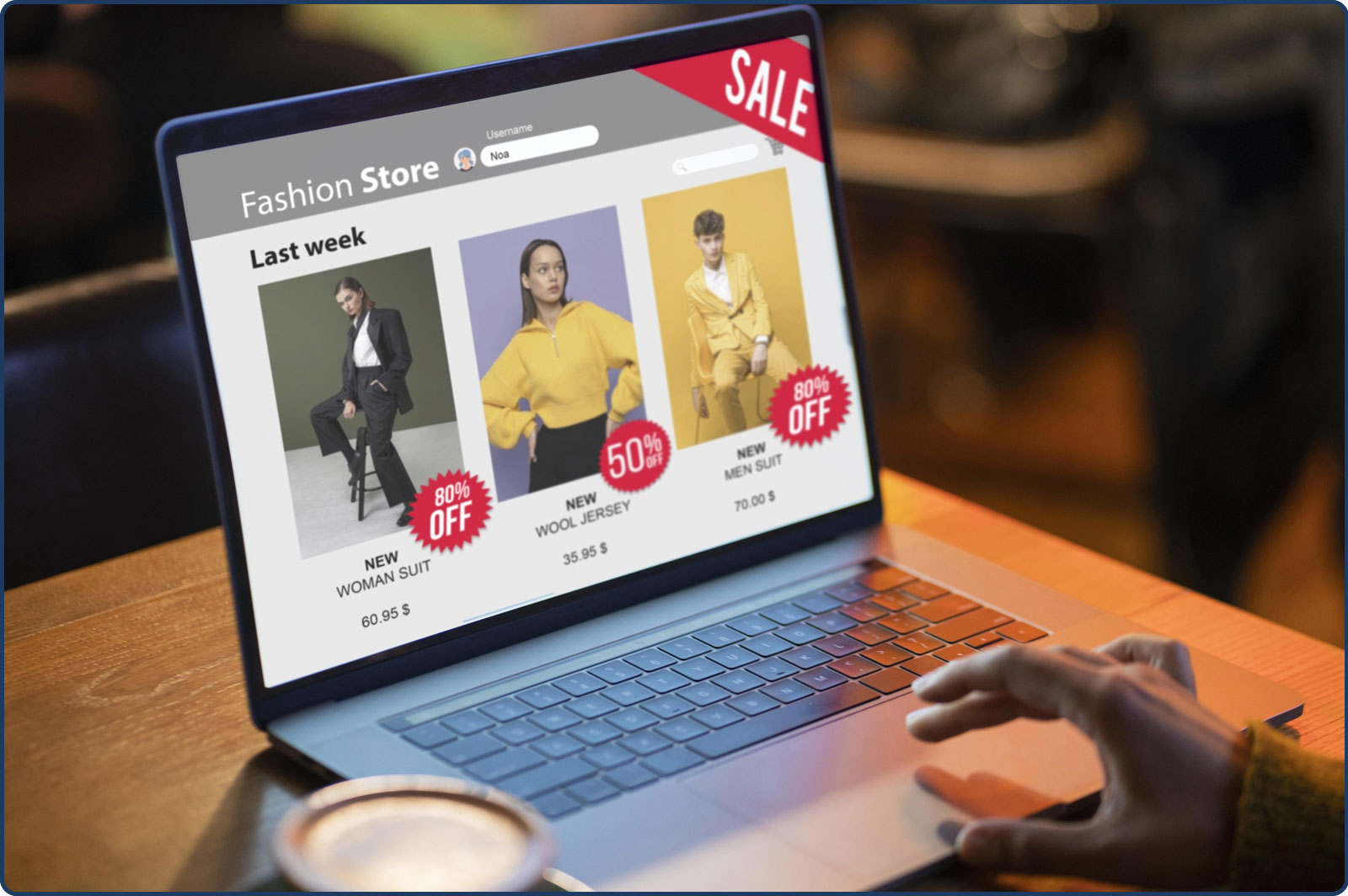
D2C brands compete on speed and experience as much as on product. A D2C build from RWS loads fast, converts on mobile first, and gives your marketing team room to run promotions, bundles, and loyalty programmes without waiting on a developer for every change.
Multi-vendor marketplaces
Marketplace builds carry a different weight of complexity — vendor onboarding, commission structures, split payments, and separate seller dashboards, all running alongside the buyer-facing storefront.
We structure these as distinct systems that share a common data layer, so vendor management doesn't slow down the shopping experience.

Headless & composable commerce architectures
A headless build separates the storefront a shopper sees from the commerce engine running behind it. That means your front end — a website, a mobile app, an in-store kiosk — can pull from the same product and order data without being locked to one platform's templating rules.
Headless commerce development is a heavier build than a standard theme, and it earns that cost back when a business needs to launch new customer touchpoints without rebuilding the commerce logic each time.
Why choose custom ecommerce over SaaS platforms?
A SaaS platform is quick to launch and genuinely the right call for many businesses. It stops being the right call once your operation outgrows its plugin ecosystem, its rate limits, or its assumptions about how a store should work.
Unlimited scalability & flexibility
SaaS platforms cap what you can do — API call limits, checkout customisation limits, catalogue structure limits. A custom build carries none of those ceilings.
Lower total cost of ownership
Licence fees, transaction percentages, and workaround plugins add up over a platform's lifetime. A custom build carries a higher upfront cost and a lower ongoing one.
Full ownership of your codebase
Everything we build for you is yours outright once the project is delivered — the source code, the architecture, the integrations. No vendor lock-in.
Enterprise ERP & CRM integrations
This is where most SaaS-based ecommerce builds run out of road. Delivering genuine ERP integrated ecommerce means connecting a storefront to the systems that already run your business — inventory, finance, customer records — and that needs more than a plugin marketplace can offer.
Custom API development & connectors. Off-the-shelf plugins sync on a schedule and often only in one direction. We build custom API connectors instead, moving stock levels, pricing, and order data between your storefront and your back-office systems in real time and in both directions.
ERP systems. We build integration layers connecting custom storefronts to NetSuite, SAP, Microsoft Dynamics, and Odoo, matching each system's own API and data structure rather than forcing a generic connector on top.
CRM & PIM synchronisation. We build synchronisation between your storefront and CRM platforms such as Salesforce and HubSpot, along with product information management systems and inventory records.
Payment gateway & custom checkout logic. We build custom checkout logic for account-based pricing, purchase order workflows, split payments, and multi-currency transactions, integrated with the payment gateways your business already uses.
Security, compliance & data protection
PCI-DSS compliant infrastructure. Card payment data is never handled by custom code we write. Every build routes payment processing through PCI-DSS compliant gateways — Stripe, PayPal, and equivalent providers — so cardholder data stays inside infrastructure built and audited specifically for that purpose.
SOC 2-aligned data practices. Data handling on every build follows structured access controls, encrypted storage, and clear separation between environments, in line with the principles frameworks such as SOC 2 are built around.
Strict NDAs & IP protection. Your business logic — pricing rules, margin calculations, vendor terms — is confidential by nature. Every custom ecommerce project starts under an NDA, and the code, architecture, and configuration we build remain your intellectual property from delivery onward.
Secure, role-based access controls (RBAC). A B2B portal usually needs several permission levels running at once — a buyer who sees only their own account pricing, an approver who signs off orders above a threshold, and an admin who manages catalogue and user access. We build role-based access control into the platform itself.
Our proven ecommerce development process
- Discovery & technical architecture mapping — Before development starts, we map your existing systems — ERP, CRM, inventory, payment providers — and plan how the new platform connects to each one. This step decides the architecture; skipping it is where most integration problems start.
- UI/UX design for high conversion — Design work here is judged by whether it moves a buyer or a shopper towards checkout, not by how it looks in isolation. Wireframes and prototypes are reviewed with you before development begins.
- Agile development & system integration — Development runs in short cycles with regular check-ins, so integration work with your ERP or CRM stays visible and testable as it happens, rather than arriving as one unverified block at the end..
- QA, security testing & launch — Every build goes through functional testing, load testing where volume matters, and a security review before launch — including the payment flow and any custom API connectors.
Custom ecommerce platform capabilities at a glance
Whichever tier you're starting at, the same platform foundation applies. The list below is the full capability set our custom builds draw from — from catalogue and order management through to the ERP-level integrations covered above.
Storefront & catalogue management
- Home page, product listing, product detail, cart, checkout, and account templates designed fresh for every project — no resold templates
- Bootstrap-based responsive theming, consistent across desktop, tablet, and mobile
- Unlimited categories and products, with attributes for colour, size, weight, and unit count
- Stock status control — in-stock, out-of-stock, and pre-order
- Regular and selling price fields, with brand and manufacturer tagging
- Multiple product images per listing, with zoom
- New, hot-offer, bestselling, and featured product flags
- Per-product or store-wide GST configuration
- Bulk import/export for categories, products, pricing, and manufacturers
- Front-end filtering by price, discount, colour, brand, and size
Customer & order management
- Cart, discount coupon, guest checkout, and registered checkout flows
- Order history, password management, and cancellation/return handling, with bank-detail capture for refunds
- Order tracking with SMS notifications, and customer product reviews
- Full order-status pipeline — pending, accepted & processing, packaged, in transit, delivered, failed, cancellation/return in process, and resolved — with automatic email and SMS notification at every status change
- Invoice printing, including GST-compliant invoices
- Failed-order listing and date-range order reporting, exportable to Excel
Admin, reporting & content
- Role-based admin accounts — super admin, catalogue manager, report manager, and other custom roles
- Dynamic content pages for FAQs, delivery policy, and payment terms
- Low-stock reporting, plus export formatted for shipping fulfilment
- SEO-friendly URLs and editable metadata on every category, product, and content page
- Configurable store settings — name, logo, address, multiple store email addresses, and homepage SEO fields
Payments, shipping & compliance
- Indian payment gateways — CCAvenue and PayU
- International payment gateways — Stripe and PayPal
- Shiprocket integration for shipment booking and tracking
- GST-compliant invoicing throughout
Retail verticals we've built for
Alongside the enterprise ERP and B2B work covered above, this same platform foundation has been used to launch retail stores in clothing, jewellery, e-books and digital notes, grocery, market research report sales, and art galleries.
